Free UK Delivery | 30-Day Returns | UK Support

By Seamus Doyle2026-05-075 min read

The Ultimate Guide to Choosing the Best Microscope Camera for UK Industrial and Lab Use

A practical buyer's guide for UK professionals in manufacturing, research, and quality control — covering resolution, sensor types, mounting compatibility, and how to integrate digital imaging into your existing optical setup without tearing your hair out.

Why Digital Imaging Matters in 2026

Modern digital imaging technology in a laboratory setting

Digital capture has shifted from a luxury to a baseline requirement in UK labs and production floors. That's the short version. The longer story? I've watched colleagues in Belfast spend hours sketching what they see down the eyepiece, only for those notes to mean nothing six months later when an audit rolls around. A decent digital imaging system eliminates that problem entirely.

This spring, UK manufacturers are under increasing pressure to document quality control processes digitally. The British Standards Institution (BSI) continues to tighten ISO 9001 requirements around traceability, and visual evidence captured through optical instruments is now expected rather than optional.

So what does this mean practically? It means your old trinocular head gathering dust needs a sensor attached to it. Or you need a standalone unit that handles both magnification and capture. Either way, the days of eyepiece-only work are numbered.

Key stat: UK industrial microscopy equipment spending grew 14.3% year-on-year in 2025, with digital imaging accessories accounting for roughly £47 million of that market (source: UK Photonics Industry Report, 2025).

Sensor Types and Resolution: What Actually Counts for a Microscope Camera

Technical specifications and sensor details for microscope cameras

Resolution isn't everything. There, I've said it. A 4K sensor sounds brilliant on paper, but if the pixel pitch doesn't match your optical magnification, you're capturing noise rather than detail.

CMOS vs CCD: The Practical Difference

CCD sensors deliver lower noise at slow frame rates — ideal for fluorescence work or long-exposure metallurgical imaging. CMOS sensors are faster, cheaper, and perfectly adequate for routine QC inspection at magnifications below 200×. For most UK industrial applications — PCB inspection, surface finish checks, particle counting — a well-matched CMOS sensor between 5MP and 12MP is spot on.

Pixel Size and Optical Matching

Here's where people trip up. Your sensor's pixel size needs to satisfy the Nyquist criterion relative to your objective's resolving power. In plain English: a 40× objective with 0.65 NA resolves features down to about 0.5µm. To capture that faithfully, you need pixels no larger than 2.5µm at the sensor plane.

Rule of thumb: Sensor pixel size (µm) should be ≤ 2.5 × (optical resolution in µm) × total magnification to sensor. For a 10× objective with 0.25 NA, that's pixels ≤ 5.5µm — most modern sensors meet this comfortably.

I've seen labs spend £3,000 on a 20MP camera only to pair it with a worn-out 4× objective. Total waste. Sort your optics first, then choose your sensor.

Integrating a Microscope Camera Into Existing Optical Workflows

Integrating a digital camera into an existing optical microscope workflow

The biggest headache isn't buying the camera — it's making it talk to everything else you've already got. Most UK labs run a mix of equipment spanning decades. I've personally encountered Olympus BH-2 frames from the 1980s sitting next to brand-new Nikon Eclipse units in the same room. (Nobody ever throws anything away in a university department, in my experience.)

C-Mount and Adapter Compatibility

The C-mount standard (1-inch diameter, 32 threads per inch) remains dominant. But watch out: you'll need a relay lens — typically 0.5× or 0.63× — between the trinocular port and the sensor. Without it, your field of view shrinks dramatically and vignetting creeps in at the edges.

Software Integration

Windows-based measurement software is standard across UK industrial settings. Look for cameras shipping with calibrated measurement tools, live annotation, and — critically — export formats compatible with your existing quality management system. PDF reports with embedded measurements save hours during ISO audits.

Can your current setup handle USB 3.0 bandwidth? That's 5 Gbps, enough for uncompressed 4K at 30fps. If you're stuck on USB 2.0, you'll max out around 2MP at decent frame rates. Worth checking before you order.

Portable and Standalone Units

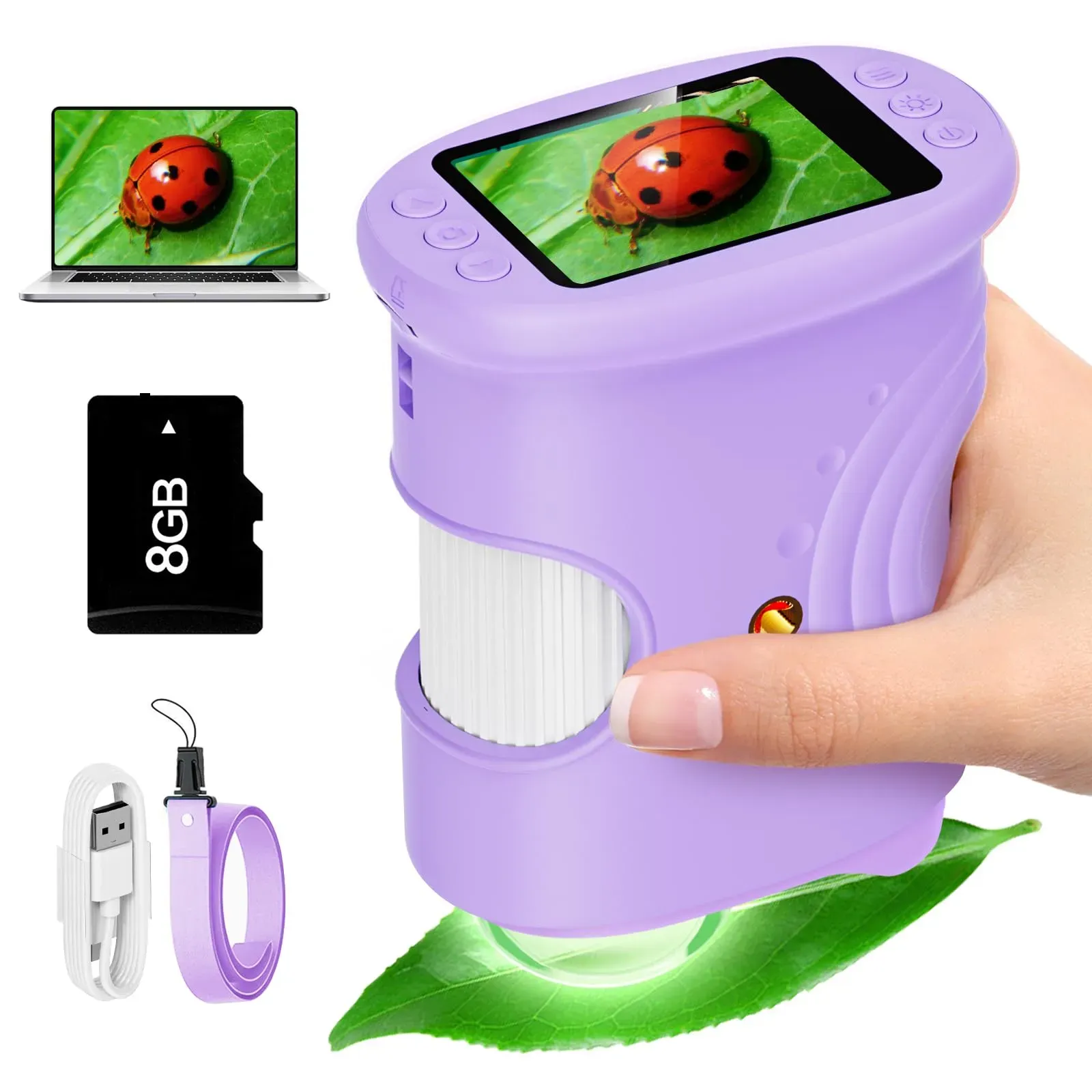
Not every application needs a full benchtop rig. For field inspection, incoming goods checks, or quick documentation on the shop floor, a handheld digital microscope with built-in screen offers genuine flexibility. The bebanghan portable unit, for instance, packs a 4K sensor and 2.0-inch LCD into a handheld form factor at just £33.99 — decent bang for your buck when you need quick visual verification without dragging samples back to the lab.

Feature Comparison: Entry-Level vs Professional Imaging Units

Comparison chart of entry-level versus professional microscope imaging units

Choosing between budget and professional digital imaging depends entirely on your application. Here's a breakdown that reflects what's actually available to UK buyers in June 2026:

Feature Entry-Level (£30–£150) Mid-Range (£150–£800) Professional (£800–£5,000+)
Sensor Resolution 2MP–5MP 5MP–12MP 12MP–20MP+
Frame Rate (live view) 15–30fps at full res 30–60fps at full res 60–120fps at full res
Sensor Type CMOS (rolling shutter) CMOS (global shutter available) CCD or scientific CMOS
Connectivity USB 2.0 / built-in screen USB 3.0 USB 3.0 / GigE / Camera Link
Measurement Software Basic or none Included (calibrated) Advanced with SPC integration
Cooling None Passive heatsink Active Peltier cooling
Typical UK Use Case Education, hobby, quick checks QC inspection, routine lab work Research, metallurgy, forensics
Example Price Point £33.99 (bebanghan handheld) £350–£700 £1,200–£4,500

The gap between entry-level and mid-range has narrowed — though only for resolution. The real differences show up in colour accuracy, dynamic range, and software capability. A £33.99 handheld won't replace a calibrated lab system, but it'll absolutely handle incoming goods inspection or field documentation.

UK Standards and Compliance for Industrial Imaging

If you're using digital imaging as part of a quality management system, compliance isn't optional. The Health & Safety Executive (HSE) doesn't directly regulate microscope cameras, but the documentation they produce often feeds into workplace safety assessments — particularly in pharmaceutical manufacturing and asbestos analysis., popular across England

ISO 17025 and Calibration Requirements

Labs operating under ISO 17025 accreditation need traceable calibration of their imaging systems. That means a stage micrometer calibration at each magnification, documented annually at minimum. Your microscope camera software should store calibration data per-objective and flag when recalibration is due.

UKCA Marking

Since January 2025, all electronic equipment sold in Great Britain requires UKCA marking. Check this before importing cameras directly from overseas suppliers — it's one of those things that's easy to overlook until a procurement team kicks it back. Products sold through bebanghan.co.uk meet current UK product safety requirements, which saves you the compliance headache.

Compliance checklist: UKCA marking confirmed | EMC Directive 2014/30/EU equivalent | RoHS compliant | WEEE registered | Low Voltage Directive compliance for mains-powered units.

The GOV.UK product safety guidance provides current requirements for placing electrical equipment on the UK market — worth bookmarking if you're sourcing from multiple suppliers.

Portable Digital Microscopy: When Benchtop Isn't Practical

Not every inspection happens in a controlled lab environment. I work in care, not manufacturing, but even I've found myself needing magnification in odd places — checking skin integrity under task lighting that's far from ideal, or examining medication packaging for tampering. The principle's the same whether you're on a factory floor or a ward corridor: sometimes you need magnification that comes to you.

Handheld Units for Field Use

The bebanghan digital microscope range includes portable units designed for exactly this scenario. At £33.99, the handheld model offers 4K capture with a built-in 2.0-inch LCD — no laptop required. You won't get the precision of a fixed-stage system, but for quick visual checks at up to 1000× digital magnification, it's sorted.

Who actually uses these? Coin and stamp collectors, sure. But also textile inspectors checking weave density on-site, electronics technicians verifying solder joints during field repairs, and QC staff doing spot checks at goods-in. The low price point means you can deploy several across a facility without budget approval turning into a six-month saga.

Limitations to Be Honest About

Handheld units lack the mechanical stability of a fixed microscope stage. At high magnification, hand tremor becomes visible. They're not suitable for precise dimensional measurement unless mounted on a stand. That said, for pass/fail visual inspection and documentation, they're genuinely useful tools rather than toys.

Frequently Asked Questions

What resolution microscope camera do I need for industrial QC work?

For routine industrial quality control, a 5MP to 12MP CMOS sensor provides sufficient detail at magnifications up to 200×. Higher resolutions (20MP+) are only justified for research-grade metallurgy or semiconductor inspection where sub-micron features must be resolved and measured with ±0.1µm precision.

Can I fit a digital camera to my existing compound microscope?

Yes, most compound microscopes with a trinocular head accept C-mount cameras via a 0.5× or 0.63× relay lens adapter. Check your microscope's photoport diameter — standard is 23.2mm or 30mm. Adapters cost between £15 and £60 and take under five minutes to fit.

How much does a decent microscope camera cost in the UK?

Entry-level handheld units start from £33.99 for portable 4K models. Mid-range C-mount cameras suitable for lab QC run £350–£700. Professional cooled sensors for research applications range from £1,200 to £4,500+. Budget should match your measurement precision requirements rather than raw megapixel count.

Do I need special software to use a digital imaging attachment?

Most mid-range and professional cameras include proprietary measurement software for Windows. Entry-level USB models often work as standard webcam devices, viewable through free software like AmScope or ImageJ. For ISO-compliant documentation, dedicated software with calibration storage and PDF report generation is strongly recommended.

What's the difference between optical and digital magnification on handheld units?

Optical magnification uses physical lenses to resolve finer detail — it increases true resolving power. Digital magnification crops and enlarges the sensor image, adding no new information. A unit advertised as "1000× digital" typically offers 50–200× optical magnification with digital zoom beyond that. For measurement work, only optical magnification counts.

Are bebanghan microscope cameras suitable for professional laboratory use?

The bebanghan handheld range at £33.99 is designed for portable inspection, education, and hobby use rather than calibrated laboratory measurement. For professional lab environments requiring traceable calibration and ISO compliance, pair a dedicated C-mount sensor with your existing optical microscope setup. The handheld units excel at field documentation and quick visual verification tasks.

Key Takeaways

  • Match sensor to optics first: A 5MP camera paired with quality objectives outperforms a 20MP sensor on worn optics every time.
  • Budget realistically: Entry-level microscope camera units from £33.99 handle documentation; calibrated measurement requires £350+ investment.
  • Check C-mount compatibility: 90% of trinocular microscopes accept standard C-mount sensors via a £15–£60 relay adapter.
  • USB 3.0 is the minimum for live work: USB 2.0 limits you to approximately 2MP at usable frame rates for real-time inspection.
  • Compliance matters in 2026: UKCA marking, ISO 17025 calibration traceability, and digital audit trails are now expected in regulated UK industries.
  • Portable units fill a genuine gap: Handheld digital microscopes at under £35 provide field-ready documentation that fixed systems can't match for flexibility.
  • Software is half the value: Measurement, annotation, and report export capabilities determine whether your imaging system saves time or creates extra work.

Ready to try Bebanghan?

Shop Now — £32.00

Bebanghan

Bebanghan brings hands-on science to British families with smart, portable microscopes designed for discovery at home and outdoors. Built for curious children, hobbyists and gift buyers alike, our range blends practical STEM learning with easy-to-use digital technology.

© 2026 Bebanghan. All rights reserved.